

You may already know that donating through a Donor-Advised Fund (DAF) is an excellent way to support charitable causes while also receiving potential tax benefits, but there are a few details to keep in mind:
Donor-Advised Fund Tax Deduction Limits
If you plan to donate cash to your donor-advised fund, your tax deduction is limited to 60% of your adjusted gross income that year. This 60% deduction limit applies through 2025 under current tax law.
You may consider spacing out your contributions over multiple years if your gift is going to be a significant percentage of your income.
Donating appreciated stock can help you reduce capital gains taxes while maximizing the amount available for charity. However, the deduction is limited to 30% of your adjusted gross income (AGI).
A donor-advised fund can be particularly beneficial when you have very high income and can take advantage of significant tax deductions.
Example Tax Deduction From a DAF
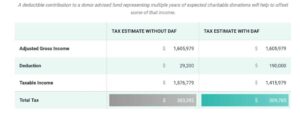
For example, let’s say you have a year with taxable income of $1 million due to a business sale, real estate sale, exercised stock options, a large stock sale, or another significant financial event. Let’s also assume you typically give $20,000 per year to a charity.
A donor-advised fund will allow this household to make a large one-time donation to a DAF equivalent to multiple years of giving, receive a large upfront tax deduction for the lump sum amount, but continue to send $20,000 annually to the charity.
We can help this household determine the optimal amount to donate to the donor-advised fund, and evaluate the benefits of a donor-advised fund compared to other charitable giving strategies:
Minimum Donation Amounts and Fees
For accounts at two of the biggest providers, Schwab and Fidelity, there is no minimum initial contribution.
Fees for the account start at 0.6% per year, and decrease as account balances grow. There are also fees for the investment funds, which can range from a few hundredths of a percent for simple index funds to higher-cost funds with varying expense ratios.
Grants—charitable gifts from the account—can be made in small amounts, typically $50 or more. For major providers such as Schwab and Fidelity, the grants are done online simply and quickly.
Wondering what the best way is to support the causes you care about while also maximizing your tax benefits? Contact us today and let us help create a charitable giving plan for you:

Matt Hylland is a financial planner and partner at Arnold & Mote Wealth Management, where he helps individuals and families make informed decisions around retirement planning, investment management, tax planning, and comprehensive financial strategy. As a flat-fee, fiduciary advisor, Matt focuses on providing objective guidance designed around each client’s goals and long-term financial needs.
Before transitioning into financial planning, Matt worked as a materials scientist for the Department of Defense, bringing a problem-solving mindset and analytical approach to his work with clients. He has been featured or quoted in nationally recognized financial publications, including The Wall Street Journal, CNBC, and Kiplinger, for his insights on personal finance and investing.
Years of experience: 10
Specializations: retirement decisions, tax-efficient strategies, investment choices, and the complex financial decisions that come with major life transitions.